Sunday 8 March 2026, 10 am.
Bat expert Alyssa Bennet of Vermont Fish and Wildlife gave a very interesting presentation on Vermont bats, their habits and habitat, how to identify them, and how some species are slowly beginning to recover from white nose syndrome (an unprecedented disease of cave-hibernating bats caused by a fungus that thrives in the cold). Vermont is home to nine bat species, five of which are now listed as endangered or threatened. These insect-eating bat species are a vital part of our state’s ecosystem and suitable, protected summer roost sites are critical to their survival, which requires places for female bats to raise their young. Our goal is for the Preserve to provide suitably sited bat houses and to monitor the results.
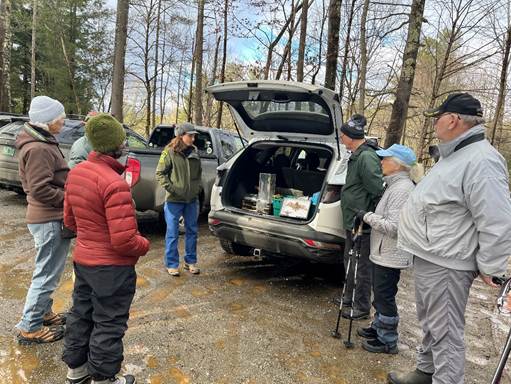
Alyssa says that bat houses on the Krusch Preserve are most likely to attract little brown (Myotis lucifugus) or big brown (Epetiscus fuscus) bats. Females of these species congregate in groups in spring through summer to give birth and rear their young. Little brown bat populations declined by up to 90% in just a few years due to WNS and are now listed as endangered in the state of Vermont. Despite the slipperiness of the trails on this warm March day, our intrepid group of eight hiked with Alyssa to see our meadow area, which she thinks is ideal for bat houses, and to the Sandblow Meadow, which she judged as too exposed to the wind to be a good site for bat nesting
For more information see Got Bats? | Vermont Fish & Wildlife Department.
 The Peter A. Krusch Nature Preserve - 316 North Cambridge Road, Cambridge, VT 05444