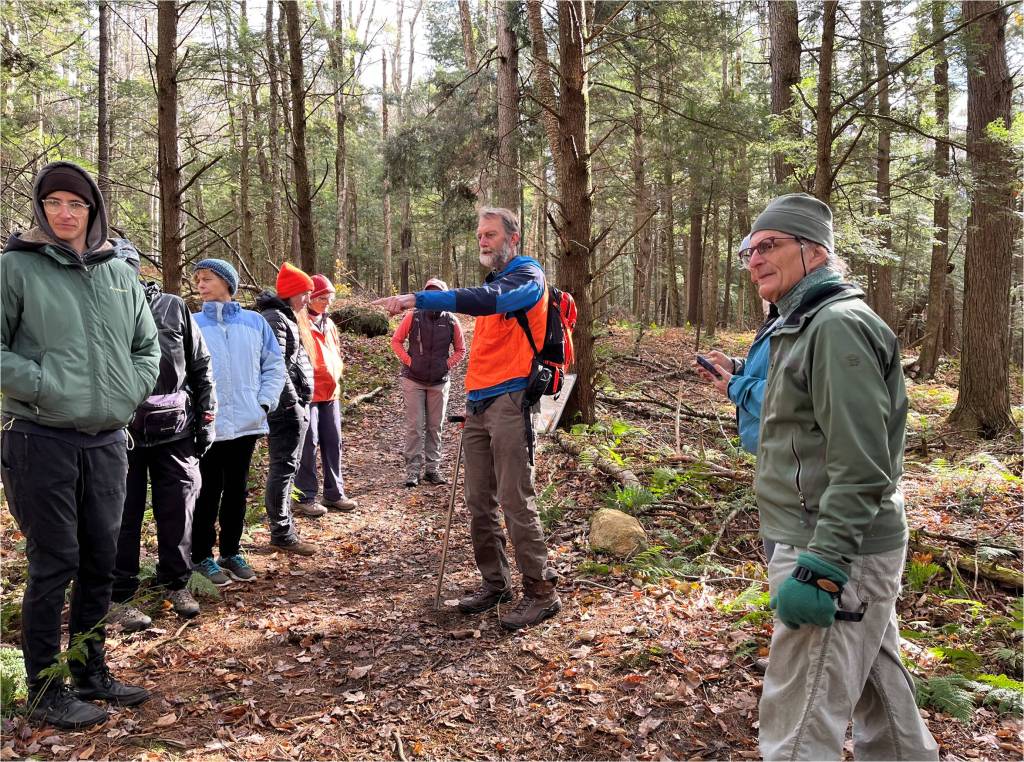
Today’s Geology Walk conducted by Stephen Wright was well attended and a great success. 18 people came braved the breezy 47 degree day under clearing skiers after a heavy rain.
In the meadow we cored soil samples, heard how it was fine sand deposited in the glacial lake about 13,000 years ago, as the glacier began to melt back from overhead in this part of Vermont, and imagined being in a canoe about 100 feet above the lakebed. He explained how glacier move “like silly putty” not liquid but not solid, how they flowed over and around our mountains, at one point with ice one mile thick over this meadow.
Above the Seasonal Brook Bridge Stephen explained that the yellowish rock along the path was sandstone from the Laurentian Mountains of Quebec, caught in the glacier, transported here and dropped in this spot. Not well worn or rounded, just pulled along as the glacier moved. He pointed out our large glacial erratic boulders and explained that that term doesn’t mean any rock left behind by the glacier but means specifically a rock of a different type from the local rocks, transported and then dropped.
At the waterfall glen, he explained about rocks forming in layers, and often as here then uplifted and tilted. Someone asked if our Vermont mountains were indeed once higher than the Himalayas, or if that was hyperbole. He said mostly hyperbole – although some of the minerals in the mountains could only be formed at depths of 6 miles below the earth’s surface. He observed that mountains have roots, and are very hard to get rid of. When rock erodes off the top they erupt a bit higher (over eons, of course).
Some of us continued to the Sandblow, where soil cores showed some dark soil above the white sand below showing the revegetation.
Stephen was a gracious leader, waiting until folks had gathered to talk and generous with his time to answer questions.

 The Peter A. Krusch Nature Preserve - 316 North Cambridge Road, Cambridge, VT 05444